• I have no doubt that improving my property is worth every penny spent. Especially in these down-turn times. Of course I want to spend my pennies in the garden—it’s what I do. But Himself would rather build shelves to hold his collection of CDs, which is really what he’d rather be investing in, because it’s what he does (write about music). But the way I look at it, CDs and books, you take ’em with you when you move, but the garden stays put. So it’s worth making it look terrific.

    According to surveys done in the not too distant past, by august bodies like the National Gardening Association  and the National Association of Retailers, I learn that:

    The average cost of landscaping is 5% of a property’s value, but can add up to 14% to its sale price. And a pretty garden can knock 6 weeks off the length of time it takes to sell.  20% of buyers say that landscaping is “very important” to them when considering a house purchase, and that trees alone add up to 7% to a home’s price. That’s all very well, but I rather suspect that landscaping to some means green lawns and evergreen foundation planting and would not mean the perennial border I planted last autumn under the front windows using a plan that Piet Oudolf designed for me to share with Trad Home readers, but which never made it into the magazine. It should look quite magnifique what with all the blues and mauves set off by splashes of shocking pink and blurs of white. Much if it was native, too, which will suit the Iowa zone. But, I digress….

    More stats are just as impressive, because they’re about lowering utility use and cost. Planting shade trees on the south and west sides help to keep your home cool and can lower costs by up to 20%. Keep the aircon unit shaded too and increase its efficiency by 10%, and lower its use by 15%.  Now that is truly something we can all relate to; save energy AND money. Need I say more? I imagine not, other than to claim that’s my perfect excuse to put my money in the soil.  Ka-CHING!
  • Oh goody! Quite a few months ago it was announced that there are three more planets in our solar system. That changed everything, and it continues. It seems that not a day goes by but what was once safe and familiar is suddenly a walk on the wild side. The things that made it possible to sit and slurp a cup of tea down while contemplating whether to wash the dog or check out the sales at TJ Maxx are constantly morphing into something dodgy.

    There are nine planets. I can breathe easy. OOPS! no I can’t. One’s feathers get so easily ruffled..I must be getting cranky. It happened again today. Reading today’s emailed installment of Boggycreek Farm’s newsletter by Carolann reminded me to catch up on our government’s latest plan to protect us from our food. That would be NAIS, or National Animal Indentification System.

    Yes, Dorothy, our ever vigilent government ag agencies want ALL farmyard beasts and fowls — and some not so barnyard — to be tagged, numbered, counted, interrogated (are you or have you ever been free range?).  I really fail to see just how that will protect us, other than providing jobs for the tech industry, which I suppose will keep them from developing yet more nefarious ways for us to harvest information…and waste time on line.

    My love of chickens is legendary, and they all had names and lived into gracious retirements,  but more of that later. This business of naming our benign critters reminds of a time back when….(drifts into seamless reveries)

    There have been other “you’re kidding, right?” moments in my life, of course. I mean, who hasn’t had the metaphorical rug yanked once or twice? And speaking of ruffled feathers, one of these goofy moments struck in garden in rural England some years ago…and may go some way toward explaining why I think birds are an essential ornament in the garden of life.

    In my life as a junior journo, back in the day when I didn’t dare turn down a freelance job, no matter how paltry the pay (wasn’t it Dr. Johnson who wrote, “No man but a fool wrote but for money.”), because, of course, say NO just once, and you’ll never be asked to dance again. I digress…I was working on a book, my first as it happens, titled “English Country Gardens”. so there I was in an English country garden in deepest rural Surrey, south of London — pure Gertrude Jekyll territory — talking to this archetypal English granny…wispy white hair escaping from hairnet, saggy stockings around ankles above stout black shoes. Floral sprig dress and apron.

    So, ordinary day in a pretty garden. We’re strolling round, admiring the herbaceous borders (where did these old dears get the energy from to manage 300 square feet of perennials, not to mention kitchen garden, orchard…it nearly kills me to struggle out of my deck chair to pluck a tomato off the vine). It was a PURRFICK day, as they say in south England, blue sapphire sky, fluffy white bits, gentle breeze, impossibly green hills, that garden…and I hear a parrot squawk. SCREEE-CH. Hullloo love. SCREEK. Hulloo lovely. Scree…

    “There’s a parrot in your apple tree”

    ‘I know, dear. M’ nephew gave it to me to look after, poor old thing.”

    And it was rather moth-eaten, in the way parrots get when they’re bored or stressed and have been plucking their feathers. Pathetic really, but clearly this little lady was doing her best to give it a happy retirement. Who wouldn’t be happy sitting in an apple tree all day?

    “So, have you had it a long time?”

    “No dear. just a few years. M’nephew, you see, he lives just over that hill there. Eric Clapton’s his name…he plays guitar. And the parrot was Jimi Hendrix’s, you see, and Eric took him when Jimi died, and now I look after him. Goodness knows what that bird’s seen.”

    Probably a few extra planets, now and then.

    Parts of this post first appeared as an editor’s blog on Traditional Home’s website as “Birds I have known, Part 1: Eric’s Bird”
    Posted 8/16/2006 2:12 PM CDT

  • The NYT is on a tear about bugs and grub, and so am I, it seems. Today’s Op-Ed has a contribution from E. J. Levy, a creative writing prof at the University of Missouri. To sum up the parts of his story, we are, he writes, “probably ingesting one to two pounds of tasty flies, maggots and mites each year without knowing it, a quantity of insects that clearly does not cut the mustard, even as insects may well be in the mustard.” This is because the FDA finds as acceptable a certain amount of bugs and bug parts in our food. I think I’ll skip the sauerkraut and its allowable thrips and stick to good old dirt.

  • My late lamented mother was fond of saying, “Everyone has to eat a peck of dirt in their life.” As I grew up, that was the refrain each time I dropped a slice of peanut-buttered bread, upside down on the floor. Five second rule? Fegeddaboutit. Straight in the mouth, having first removed the most obvious chunks of gravel and wisps of dog hair. When her beloved grandson, my boy, put his first worm between his teeth she was nearly apoplectic…with joy. “He’ll grow up fine and strong,” she forecast — the Irish soothsayer in her coming out. Guess what. She wasn’t wrong, (DG).

    So imagine my delight, and my own touch of smug Irish granny showing, when I read in today’s New York Times how microbes are good for us! Told you so. And that sanitized and steam-cleaned children are more prone to allergies and immune weaknesses.

    As a gardener I know how good microbes are for the soil: they make compost from kitchen waste, improve soil texture, and generally keep plants healthy. Lose them, lose the garden’s sustainability. So it stands to reason, if we lose ’em in our gut, we lose a margin of our own sustainability.

    Worms, too, are especially important to soil viability; in my sticky yellow clay garden I rejoice at the sight of a worm; their numbers are growing, but still I’ve been seen scaring off robins as they tug those little rubbery guys from the soil. According to several doctors consulted by the NYT’s reporter, it turns out worms are good for us, too. Pig whipworm, which is not long-lasting in the human body, has beneficial effects treating Crohn’s disease, ulcerative colitis and some other inflammatory bowel diseases. Children raised around farm animals and so exposed to a variety of worms, not to mention good old dirt, are less likely to develop allergies. In her book, Why Germs are Good, author Mary Ruebush explains why dirt is important, or at least not something to be afraid of. Our bodies are full of microbes and we should keep it that way to stay healthy. Put away the antibacterial handwipes and pick up a bar of soap. Don’t freak when Jr shines a dirt-begrimed smile at you. It part of the peck. But I think I’ll leave the worms in the garden.

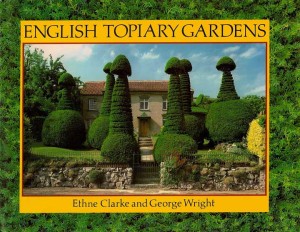
  • I love it, and once wrote a book on it, titled English Topiary Gardens, for which I traveled the length and not-so-wide breadth of England hunting for topiary gardens. topiary-cover1They weren’t hard to find since topiary breeds a showmanship of sorts, with the best examples of the pruner’s art ghettoed in the front garden, framing front doors and generally shouting, “OVER HERE.”

    Topiary lends itself to strong emotion. It’s a pure art, and as such appeals to emotions. Hence the phrase, “I know what I like,” which is generally followed by “You call that art.” So, topiary. Love it or hate it. And when a gardener loves topiary watch out, as I witnessed on an Ovation TV program that aired last nite (and will air several more times this month; Ovation is rather new, I think, and programming is a work in progress). Titled A Man Named Pearl, the story is about the redoubtable Mr Pearl Fryer who embarked on his topiary path as a personal statement about the fallacies of racial stereotypes. A proud African American man who lifted himself out of poverty, Mr Fryer learned the art by watching a few nursery demos. The rest, as they say is history. Today, Mr Fryer’s suburban garden, in a financially challenged South Carolina community, is a stop on the garden-visiting, red-hat wearing, tourist-in-search-of-the-“real America” trail. He keeps his garden gate wide open, and his tractor and trimmers buzzing until all hours; the neighbors used to wonder, what could he be doing by floodlight?

    Resistant at first, the same neighbors now ride the topiary bandwagon, firing up the trimmers to add yet more topiary texture to their trim ranch houses. A local diner-owner asked Mr Fryer to prune up her shrubs in the parking lot. Now he tends them weekly, and Mr Fryer, and the charming Mrs Fryer, dine there for free once a week. Gardeners are such good people…and Mr Fryer is extremely fortunate in his tolerant wife: as she says, “if he’s happy, I’m happy.”

    Now, anyone reading this who calls themselves a gardener will renember that they learned their best and most valuable lessons at the knee of an older gardener. In that spirit, as well as sharing his skill and knowledge with anyone who visits, Pearl Fryer visits local schools and brings the kids into his garden. There they learn lessons about more than topiary and gardening, absorbing from Mr Fryer and his obsession the virtues of patience, tolerance, diligence and belief in one’s own self worth. And that, in my opinion, meanshe has accomplished his mission, and made something beautiful in the bargain.As well as earning his name; he’s a real pearl among gardeners.

    man_named_pearl_160x120

    Click here to watch the Ovation TV online video of A Man Named Pearl.

  • “I work in the garden, I look at the flowers and shrubs and trees and discover in them an exquisiteness of contour, a vitality of edge or a vigor of spring as well as an infinite variety of color that no artifact I have seen in the last sixty years can rival….Each day, as I look, I wonder where my eyes were yesterday.”  Bernard Berenson

    Welcome to my new blog site. I have migrated from the web pages of Traditional Home magazine, where, for the past nearly six years I’ve been the Garden Editor. There, I used my space and enthusiasm for all things garden-centered to expand the content of the printed page. I intend to do the same here, but with more vigour and with a much wider scope. And that’s where cyber publishing as it all over the bricks-and-mortar guys. With blogs like this one, each person becomes their own publisher and editor, filtering their own information bundle and shaping it to best suit their needs. Each person, too, becomes a reporter, some with greater success than others, but what I’ve always enjoyed about the community of gardeners is their willingness to share their knowledge. It’s how we learn to become gardeners. Is any other enterprise as open-platform as gardening? The only one that I can think of is the internet. Making the two a perfect and complementary pair.